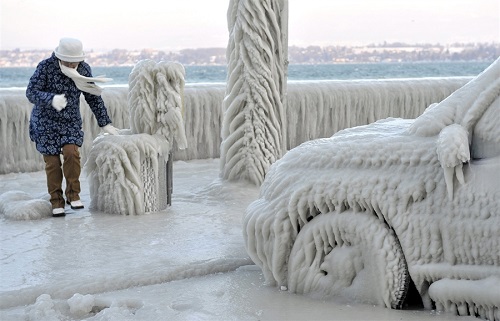
Showing posts with label winter. Show all posts

Dec 2, 2014

How to Prevent, Identify and Treat Frostbite

Frostbite on fingers
Jack Frost nipping at your nose? Well, it’s that time of year to worry about getting nipped too hard by our cold natured friend. The colder weather makes me think ofissues that I have to watch out for and one of them is frostbite. Frostbite can affect anyone and you don’t have to hike all the way up Mount Everest to feel its effects. As we think of prepping, one aspect we prepare for is bugging out or being without shelter due to societal collapse, natural weather event or some other calamity that causes major upheaval. With winter temperatures dropping, being outside could quickly cause cold injuries. Knowing how to prevent frostbite could be a valuable prepping skill you need to know if faced with that prospect.
The easiest thing to do is stay warm and dry and regulate your body temperature. Make sure you have proper cold weather equipment and you are able to reduce your exposure to the cold. That might prove impossible in some situations. Gloves are often overlooked when we think of prepper supplies but even with gloves, most are not designed to keep your fingers protected against every harsh environment. If wet, even the most expensive gloves will be no better at keeping your hands warm than a wet bag.

What are the symptoms of Frostbite?

Frostbite is an injury caused by the freezing of your skin and the underlying fluids and tissues. Frostbite is most common on the extremities or any typically unexposed areas of skin. Fingers, toes, nose, ears, cheeks or your chin are where you are most likely to get frostbite because when you are cold, the blood in your body retreats towards the core to keep the vital organs functioning and warm. Severe frostbite requires medical attention because it can literally destroy skin, tissues, even muscle and bones.

How to tell if you have frostbite

Severe Frostbite destroys tissue.
Nasty, huh? Severe Frostbite destroys tissue and that means it doesn’t always grow back.
The symptoms of frostbite include the following:
  • Initially cold skin and a prickling or tingling feeling. This can be felt in early, less severe forms and most of us have been so cold that we felt numb before.
  • Numbness
  • Discolored skin. It could be red, white, even blue or grey.
  • Hard or waxy looking skin
  • You could experience clumsiness or disorientation due to muscle and joint stiffness.
  • Blistering after your skin rewarms. This is a serious sign of frostbite.
Frostbite generally occurs in several stages and takes time depending on the temperature and your exposure to the cold.
Frostnip – Frostnip is the first stage of frostbite and is what most of us who have lived for any amount of time and been outdoors have experienced. With frostnip, you skin turns red and feels obviously very cold. Your skin could also become paler as in your fingertips which will lead to prickly feelings and numbness. When you begin to warm up you may feel pain but this passes and frostnip does not cause any permanent damage and is usually remedied with some warmer temperature and a nice mug of cocoa.
Superficial Frostbite – The second stage of frostbite is red skin that turns white or pale. As this happens, ice crystals may start to form in the tissue. There is no way you will know that this is happening of course and your skin may actually start to feel warm. If you get out of the cold at this point you may notice that your skin appears blue, purple or splotchy and will start to sting, burn and swell. Blisters may appear 24 to 36 hours later.
Severe Frostbite – The longer you are exposed to the cold, the effects of frostbite damage all layers of the skin including the tissues underneath. Numbness, loss of sensation including any pain or discomfort is a sign that your tissues have died essentially. Your joints or muscles may stop working and you will have large blisters form after you have warmed back up. This is the point that skin turns black, hard and you will start losing things that you used to have. This is not good and it’s very important to recognize the signs of frostbite early to prevent this from ever happening. You do not want to deal with any injuries during a grid down or bug out scenario, but frostbite could lead to worse problems. If you have signs of superficial or severe frostbite you should seek medical attention immediately.

Who is more at risk for developing frostbite?

There are some factors that will increase your risk for frostbite:
  • Medical conditions that affect your ability to feel or respond to cold. Diabetic Neuropathy is one that comes to mind so if you have people in your Prepping group who have diabetes, this is something to watch out for.
  • Dehydration – another reason to ensure you have plenty of water even when it’s cold outside and you don’t think you are losing any from sweat.
  • Alcohol or drug use – You do not want to be too stoned to know you are losing your fingers.
  • Previous frostbite or cold injuries. Once you have been frostbitten, you are more susceptible to the effect of cold again.
  • Infants and Seniors are less able to keep themselves warm.
  • High altitudes reduce the oxygen supply and increases the risk of frostbite.
Warm your hands by sticking them in your armpits.

How to treat frostbite?

Frostnip doesn’t require any treatment and usually just getting warm and dry will reduce any effects from the cold. The longer your exposure, the more risk you have of damage and complications from frostbite. Here are some ways to treat frostbite:

If you can seek shelter

  • Get out of the cold- yes, the simplest things are the best usually. Once you are inside someplace warm, remove wet clothing and dry exposed areas.
  • Gently rewarm areas that are in pain. You can soak hands and feet in warm (not hot) water. Water temperature between 98 and 108 is perfectly fine to restore warmth to your skin. The water temperature should only feel warm and you should have someone who hasn’t been affected test the temperature or you can stick an unexposed body part like an elbow in the water to test if you do not have a thermometer.

If you can’t get to shelter

  • You can warm your hands by sticking them in your armpits as close to the body as possible. We were taught to do this in the Army with our battle buddy and thankfully I never had to put that in place. If we were experiencing frostbite we were supposed to stick our hands in our buddy’s armpits or our feet on their belly. Can you imagine how much fun that would be?
  • If there is any chance you will be freezing again, don’t thaw out! This can exacerbate the condition.
  • Take pain medication like Advil, Motrin IB which should be in your first aid kit.
  • Don’t walk on your feet if they are frostbitten. You can cause more injury by breaking off broken dead pieces of your skin.

Medical Treatment of Frostbite

Assuming you are at a point that you can begin healing, begin with rewarming the skin. As this happens, the skin may turn soft and look reddish or purple. Slowly move the affected areas as you can begin to feel them again. Wrap the tissue loosely with sterile bandaging and elevate any areas to reduce swelling.
Severe cases of frostbite will destroy skin so amputations may be necessary. Again, this is not an injury you ever want to have but in a grid-down environment, make sure you do your best to avoid this.

UNDERSTANDING HOW YOUR BLOOD REACTS TO COLD IS A LIFESAVER

Every winter we are bombarded by information about the cold and how to protect ourselves from it and from health issues associated with it.
Wrap up warm, keep one room heated to a minimum 18*C, avoid hypothermia, eat and drink warm food,  get the boiler serviced to avoid carbon monoxide poisoning, turn off the Christmas tree lights to avoid fire. It’s endless.
snow-love-lyraCold
Every winter in the UK upwards of 20,000 extra deaths occur that are attributed in one way, or another to the cold. These are referred to as ‘excess deaths from all causes’ on the official statistics. Now that wording makes it sound like the medics record which deaths are caused by the cold. In some cases they do, but in mostly they don’t, the figure is derived by taking the figure for the deaths recorded during non-winter months and taking it away from the winter tally, the number left is the excess deaths from all causes figure.
Now, some things that happen in winter are fully understandable and clearly lead to more deaths than would occur in drier warmer weather. Road accidents, domestic boiler incidents, house fires, drowning from falling through ice, asthma, pneumonia, falls, influenza and so on all have a higher incidence level in winter than at any other time of year.
There are however other deaths that occur, that are directly attributable to cold weather that never even get a mention as weather related. We are all aware that heavy duty snow shovelling can cause a person to keel over with a heart attack, but this is not the main cause of heart attacks during cold weather. Heart attack and strokes, or to give them their proper names, cardiac arrest and cerebro-vascular accidents are responsible for thousands of cold weather deaths each year. They are listed on the statistics as exactly what they are, but as a heart or brain does not have ‘packed up due to cold weather’ stamped on it at autopsy it’s hard to absolutely say the death was caused by the weather.
Even though it was.
These two conditions are entirely different but they do have one thing in common…blood. Both conditions are caused by a clotting of, or restriction of the flow of blood through an organ, namely the heart and/or the brain, and this is where blood supply comes in.
Although blood is a liquid, it’s viscous, it has a stickiness to it that some fluids, such as water, don’t have. Like motor oil, blood becomes more viscous if its left in the open air, and it becomes more viscous when it is cooled, and less viscous when it’s warmed. So, when it’s trundling around in your blood vessels, for the most part all is well, it’s warm and fluid and goes on its way doing its thing.
In some parts of your body blood vessels are far nearer the surface than you might think. Look at the inside of your wrists, your jugular vein that you may see pulsing in your neck. The veins visible at your temples, and in the case of newborns under the thin skin of their scalp. Here the blood dissipates heat far more readily than it does from other parts of your body. When it cools, it becomes a little stickier, a little more viscous. Cool it further still, like on a really cold day, and it becomes even more viscous. Sticky blood cells stick together and form tiny clumps, which turn into bigger clumps quite quickly, certainly within a couple of hours.
So. Let’s have an example.
We’ll call him John. John has a desk job in the city, he travels by train as the congestion charge is exorbitant.
He is fit, going to the gym three times a week and plays football on a weekend. That and running around after his three kids is enough he feels. He gets up, showers and has a healthy breakfast of whole wheat cereal and fruit, a glass of orange juice and sets off.
He drives to the station, parks and makes his way to the platform. He is wearing a shirt, suit and tie and a thick overcoat. He realises when he is standing on the open platform that he’s shivering, he has left his gloves and scarf in the car and doesn’t have time to fetch them.
Still the train is hopefully running on time and will be here soon. The blood travelling around John’s’ body is cooling as it moves past his unprotected wrists and up to his unprotected neck, a shirt and tie is not that warm, and on to his unprotected head. As it moves back down into the protected areas of his body it warms and becomes more fluid again.
He is shivering which increases his heart rate, making the blood move faster, so more blood is passing the exposed areas more often and passing through the warm areas at a faster rate. After a few minutes his blood is slightly more sticky than it was when he arrived on the platform. He continues to shiver. A couple of blood cells have agglutinated,  clumped together in one of his veins.
He doesn’t know this has happened, he feels nothing, but the process leading to John’s’ possible demise has begun. The longer he stands there in the cold the more cells will bump into the still microscopic clump and stick to it, increasing its size.
At this point there are several scenarios:
1. The clot increases in size lodges in his brain, blocks the flow of blood and he has a stroke.
2. The clot increases in size lodges in his lungs and he has a pulmonary embolism.
3. The clot increases in size, lodges in his heart, blocks the flow of blood and he has a cardiac arrest.
4. The train comes, John warms up before the clot increases in size and he survives this particular encounter.
Today is not John’s lucky day. The train is late. The thing with clots is the bigger they get the more blood cells bump into and stick to them. By the time John gets on the train fifteen minutes later the clot is no longer microscopic, but it is stuck in place for now. John feels a touch off colour but has put it down to the shivering and shaking he has been doing for 20 minutes.
He gets of the train and makes his way to his office, glad to be in the warm at last. As he settles at his desk, he warms up, his blood gets less sticky and starts moving at its proper rate around his body. The clot in his vein gets less sticky also, the clot becomes less stable as his blood warms.
John doesn’t feel too good. He’s a bit pale, his chest is a little tight, the fingers on his left hand feel odd, his left arm is tingling and there’s a weird ache in his jaw. These sensations pass almost as quickly as they arrived so he has another cup of coffee and settles down to get some work done.
Looking out of the window John can see it’s started to snow. An hour later it’s snowing faster and at 4pm he decides to head home, an hour before he usually does but the weather is worsening.
Predictably his train is delayed. Standing on the draughty platform because the waiting rooms are all full of other like-minded individuals, he pulls up his collar and stamps his feet to stay warm.  Just as it did in the morning his blood starts to get a bit sticky, it’s not flowing as well as it usually does due to the cold.
The train comes and an hour later he is in his car heading home. It’s only a short journey from the station so the car doesn’t get that warm.
The back wheels of his car spin a bit as he drives up the small incline of his drive. The snow is six inches deep and shows no sign of slowing. He will need the car tomorrow and so decides to play with the kids for half an hour and then clear it off, putting down some rock salt and grit so that it’s clear for the morning.
This time he is prepared for the cold and puts on full cold weather gear. Hat, scarf, gloves and windproof coat. Within minutes he is sweating and feels a little dizzy. His warm blood has destabilized the clot and bits of it are breaking off. With no warning his chest tightens, he tries to shout for help but hasn’t got the breath to do so. Feeling like a huge weight is crushing him he falls sidewards, hitting the car, setting of the alarm. By the time his wife comes outside to see why the car alarm is going off John is dead. He was 39 years old.
Many people die each year of cold related strokes, heart attacks and pulmonary emboli. Even wrapped up, some people prone to sticky blood will still die, but a great many more would survive if they dressed in weather appropriate clothing.
It’s not rocket science that the colder it gets the more we need to wrap up. Cover your head neck and wrists when out in extreme cold. The ankles also have vessels near the surface so socks are a must, and boots are needed in the snow or when trouser legs are likely to get soaked exposing the skin to excessive cold. Wearing several layers means you can take something off if you get too hot and makes managing your temperature far easier.
Do you remember your mother shouting:
 “Don’t forget your hat, scarf and gloves or you’ll catch your death”?
She had a point.
Stay safe this winter
Take care

Nov 18, 2014

NASA Admits That Winters are Going to Get Colder…Much Colder

Ice_Storm_by_NOAA

The Maunder Minimum (also known as the prolonged sunspot minimum) is the name used for the period roughly spanning 1645 to 1715 when sunspots became exceedingly rare, as noted by solar observers of the time.

Like the Dalton Minimum and Spörer Minimum, the Maunder Minimum coincided with a period of lower-than-average global temperatures.

During one 30-year period within the Maunder Minimum, astronomers observed only about 50 sunspots, as opposed to a more typical 40,000-50,000 spots. (Source)

Climatologist John Casey, a former space shuttle engineer and NASA consultant, thinks that last years winter, described by USA Today as “one of the snowiest, coldest, most miserable on record” is going to be a regular occurrence over the coming decades.

Casey asserts that there is mounting evidence that the Earth is getting cooler due to a decline in solar activity. He warns in his latest book, Dark Winter that a major alteration of global climate has already started and that at a minimum it is likely to last 30 years.

Casey predicts food shortages and civil unrest caused by those shortages due largely to governments not preparing for the issues that colder weather will bring. he also predicts that wickedly bitter winter temperatures will see demand for electricity and heating outstrip the supply.

Casey isn’t alone in his thinking. Russian climate expert and astrophysicist Habibullo Abdussamatov goes one step further and states that we are at the very beginning of a new ice age.

Dr. Abdussamatov points out that Earth has experienced such occurrences five times over the last 1,000 years, and that:

“A global freeze will come about regardless of whether or not industrialized countries put a cap on their greenhouse gas emissions. The common view of Man’s industrial activity is a deciding factor in global warming has emerged from a misinterpretation of cause and effect.” (source)

Don Easterbrook, a climate scientist based at Western Washington University predicted exactly what Casey is saying as far back as 2008. in his paper ‘Evidence for Predicting Global Cooling for the Next Three Decades’ he states:

Despite no global warming in 10 years and recording setting cold in 2007-2008, the Intergovernmental Panel on Climatic Change (IPCC) and computer modelers who believe that CO2 is the cause of global warming still predict the Earth is in store for catastrophic warming in this century. IPCC computer models have predicted global warming of 1° F per decade, and 5-6° C (10-11° F) by 2100 which would cause global catastrophe with ramifications for human life, natural habitat, energy, water resources, and food production. All of this is predicated on the assumption that global warming is caused by increasing atmospheric CO2 and that CO2 will continue to rise rapidly.

The list of climate scientists that are moving into the global cooling camp is growing, many of them base their views on past climate records and  history suggests a link between diminished solar activity and bitterly cold winters, as well as cooler summers, in the northern hemisphere.

“My opinion is that we are heading into a Maunder Minimum,”  said Mark Giampapa, a solar physicist at the National Solar Observatory (NSO) in Tucson, Arizona. “I’m seeing a continuation in the decline of the sunspots’ mean magnetic field strengths and a weakening of the polar magnetic fields and subsurface flows.”

David Hathaway of NASA’s Marshall Solar Physics Center explains:

“We’re at the sunspot maximum of Cycle 24. It’s the smallest sunspot cycle in 100 years and the third in a trend of diminishing sunspot cycles. So, Cycle 25 could likely be smaller than Cycle 24.”

A NASA Science News report of January 2013 details the science behind the sunspot-climate connection and it well worth reading. It should be remembered that since the report was written Solar cycle 24 has been proven to be not the smallest cycle in 50 years, but the smallest for more than 100 years. The last one with sunspot numbers this low was 1906, solar cycle 14.

“Indeed, the sun could be on the threshold of a mini-Maunder event right now. Ongoing Solar Cycle 24 [the current short term 11 year cycle] is the weakest in more than 50 years. Moreover, there is (controversial) evidence of a long-term weakening trend in the magnetic field strength of sunspots. Matt Penn and William Livingston of the National Solar Observatory predict that by the time Solar Cycle 25 arrives, magnetic fields on the sun will be so weak that few if any sunspots will be formed. Independent lines of research involving helioseismology and surface polar fields tend to support their conclusion.”

Livingston and Penn are solar astronomers With the NSO (National Solar Observatory) in Tuscon, Arizona. They use a measurement known as Zeeman splitting to gather data on sunspots. They discovered in 1990, that the number of sunspots is dropping and that once the magnetic field drops below 1500 Gauss , that no sunspots will form. (A Gauss is a magnetic field measurement. The Gauss of the Earth is less than one). If the decline continues at its present rate they estimate that the Sun will be spot free by 2016.

If these scientists are correct, we are heading into a period of bitterly cold winters and much cooler summers. Imagine year after year of ‘polar vortex’ winters that start early, finish late and deliver unprecedented cold across the country. Cool wet summers will affect food production, as will floods from the melting snow when spring finally arrives.

The American Meteorological Society Journal gives the following information regarding cold related deaths in comparison to heat related deaths in the United States from 1979-1999. The article is entitled Heat Mortality Versus Cold Mortality.

During the study period from 1979 to 1999 a total of 3,829 people died from excessive heat across the United states. An average of 182 deaths per year. For the same time period 15,707 people died of cold, an average of 748 deaths a year.

Based on these figures cold kills four times more people than heat. If these scientists are right you can expect that figure to rise dramatically as energy demand outstrips supply. Power supplies are also impacted by ice storms and heavy snow which will lead to more outages and the disruption that brings.  Generally the infrastructure will fail to cope with month after month of excessive cold. Transportation is severely impacted by weather events and that has the knock on effect of hitting the economy as people struggle to get to work. For the unprepared regular food deliveries not making it to stores will leave many hungry and increasingly desperate.

The consequences of global cooling are huge and those who fail to consider it as a possibility are risking their lives and the lives of their families.

http://www.thedailysheeple.com/nasa-admits-that-winters-are-going-to-get-colder-much-colder_112014#sthash.pGsQOSAB.dpuf

Sep 9, 2014

Are You Prepared For An Extremely Bitterly Cold Winter? Solar Activity Is At A 100 Year Low

Are you ready for bone-chilling cold this winter? The Old Farmer’s Almanac and other weather forecasters that rely on solar activity as a factor in their weather forecasts are projecting that this upcoming winter will be bitterly cold. Solar activity is at a 100-year low, and even though we were supposed to be in the midst of a solar maximum this year, our sun has been eerily quiet. So precisely what in the world is going on?

Are You Prepared For An Extremely Bitterly Cold Winter Solar Activity Is At A 100 Year Low
 
There have been other periods throughout history when solar activity has been extraordinarily quiet, and those times have corresponded with periods of extreme cold. For example, the “Maunder Minimum” which stretched from 1645 to 1715 corresponded with the most bitterly cold period that the earth experienced in the last 1000 years. So could we be heading toward another “mini-ice age”? That is a question that some scientists are now beginning to ask.
 
Clearly, something unusual is happening with our sun. The following is from a Universe Today article that was posted back in July…
Our nearest star has exhibited some schizophrenic behavior thus far for 2013.
By all rights, we should be in the throes of a solar maximum, an 11-year peak where the Sun is at its most active and dappled with sunspots.
Thus far though, Solar Cycle #24 has been off to a sputtering start, and researchers that attended the meeting of the American Astronomical Society’s Solar Physics Division earlier this month are divided as to why.“Not only is this the smallest cycle we’ve seen in the space age, it’s the smallest cycle in 100 years,” NASA/Marshall Space Flight Center research scientist David Hathaway said during a recent press teleconference conducted by the Marshall Space Flight Center.
In a previous article, I noted that scientists are absolutely baffled by this. So far, nobody can explain why this solar cycle is so weak…
The Sun is acting weird. It typically puts on a pageant of magnetic activity every 11 years for aurora watchers and sungazers alike, but this time it overslept. When it finally woke up (a year late), it gave the weakest performance in 100 years.
The good news is that this kind of thing has happened before.

The bad news is that when solar activity slows down dramatically it tends to correspond with extremely cold weather as the Times of India recently explained…
Predictions that 2013 would see an upsurge in solar activity and geomagnetic storms disrupting power grids and communications systems have proved to be a false alarm. Instead, the current peak in the solar cycle is the weakest for a century.
Subdued solar activity has prompted controversial comparisons with the Maunder Minimum, which occurred between 1645 and 1715, when a prolonged absence of sunspots and other indicators of solar activity coincided with the coldest period in the last millennium.
Certainly solar activity is just one of the factors that influences our weather and many other factors are involved as well.

But it is undeniable that during the last “Little Ice Age” in Europe there were very few sunspots…
Times of depressed solar activity seem to correspond with times of global cold. For example, during the 70-year period from 1645 to 1715, few, if any, sunspots were seen, even during expected sunspot maximums. Western Europe entered a climate period known as the “Maunder Minimum” or “Little Ice Age.” Temperatures dropped by 1.8 to 2.7 degrees Fahrenheit.
Conversely, times of increased solar activity have corresponded with global warning. During the 12th and 13th centuries, the Sun was active, and the European climate was quite mild.
And the lull in solar activity that we are experiencing now is causing many, including the Old Farmer’s Almanac, to project that we have a bitterly cold winter ahead of us…
The Farmers’ Almanac is using words like “piercing cold,” “bitterly cold” and “biting cold” to describe the upcoming winter. And if its predictions are right, the first outdoor Super Bowl in years will be a messy “Storm Bowl.”
The 197-year-old publication that hits newsstands Monday predicts a winter storm will hit the Northeast around the time the Super Bowl is played at MetLife Stadium in the Meadowlands in New Jersey. It also predicts a colder-than-normal winter for two-thirds of the country and heavy snowfall in the Midwest, Great Lakes and New England.
“We’re using a very strong four-letter word to describe this winter, which is C-O-L-D. It’s going to be very cold,” said Sandi Duncan, managing editor.
That doesn’t sound very fun.

So has the Old Farmer’s Almanac been accurate in the past?
 
According to their website, they claim an 80 percent accuracy rate…
The Old Farmer’s Almanac, first published in 1792 during the first term of George Washington, has always watched the weather. Our famous long-range weather forecasts are traditionally 80 percent–accurate.
We will see what happens this year.

For North America, the Almanac is predicting that we will see “below-normal temperatures” and “above-normal snowfall”…
According to the newest edition of North America’s oldest continuously published periodical, a decline in solar activity combined with ocean-atmosphere patterns in the Pacific and Atlantic will result in below-normal temperatures and above-normal snowfall during most of the winter across much of the United States.
“This winter is shaping up to be a rough one,” says Janice Stillman, editor of The Old Farmer’s Almanac. “Sweaters and snow shovels should be unpacked early and kept close by throughout the season. The good news is that the extra precipitation—which will fall as rain or snow depending where you are—will help with any drought issues left over from the summer.”
So if you like winter weather, it looks like this will be a good year for you.

For the rest of us, we will just have to wear lots of warm clothing and stay inside a lot.
 
But of course the much bigger story is what this could mean for the years ahead.
 
Are we now moving into a time similar to the “Maunder Minimum” when solar activity will be very low and global temperatures will decrease?
 
Could it be possible that Matthew Penn of the National Solar Observatory and others are correct and that we are heading into a new mini-ice age?
 
Let’s certainly hope not, but without a doubt something very strange is happening to our sun.
Only time will tell what that means for our future.
This article was written by Michael Snyder and originally published at The Truth